
Task 4: Making Predictions
Objective: Describe what you think will most likely happen next in the picture, using future language and logical reasoning based only on what you see.
What the Task Requires
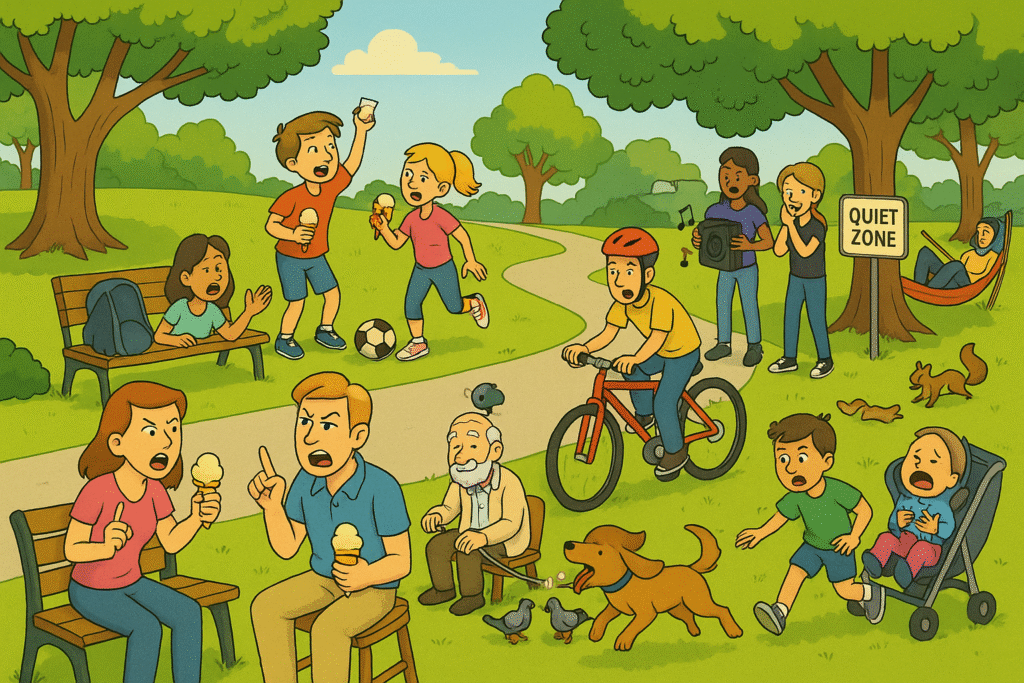
You’ll be shown the same image from Task 3, but this time, you must make predictions about what is likely to happen next.
You must:
- Speak for 60 seconds
- Use future tense and modals of possibility (e.g., will, might, could)
- Make logical, realistic predictions based only on visual evidence
- Demonstrate ability to explain why you think those things will happen
Time Limits
- Preparation Time: 30 seconds
- Speaking Time: 60 seconds
How This Differs from Task 3
| Task | Your Job | Tense Used |
| Task 3 | Describe what is happening now in the picture | Present continuous |
| Task 4 | Predict what will/might happen next, based on what you observe | Future + Modals |
You must now shift from describing visible actions to speculating what could happen next.
Scoring Categories
| Scoring Area | What the Examiner Looks For |
| Coherence & Meaning | Are your predictions clear, logical, and well-supported by the image? |
| Lexical Range | Do you use a variety of future and modal expressions accurately? |
| Listenability | Is your speech smooth, connected, and easy to follow? |
| Task Fulfillment | Do you make enough predictions and explain them clearly within 60 seconds? |
What to Do During the 30-Second Preparation Time
Use this limited time to:
1. Quickly Scan the Whole Image Again
- Ask: What actions or situations could lead to something else happening?
2. Identify 4–5 Predictable Moments
Look for:
- Movement (e.g., running, biking)
- Conflict (e.g., arguing, danger, noise)
- Tension (e.g., animals, falling items, upset people)
- Cause and effect situations
3. Write Quick Prediction Keywords
Examples:
- “bike crash,” “dog runs away,” “music complaint,” “child falls,” “ice cream melts”
Memory Framework: P.R.E.D.I.C.T.
Lancity’s official framework for Task 4
| Step | What It Means | What to Do |
| P | Pick the key situations | Choose 4–5 actions or scenarios that might logically lead to something else |
| R | Refer to specific people | Identify individuals clearly (e.g., “the man on the bike”) |
| E | Explain your logic | Give a reason for each prediction (cause and effect) |
| D | Describe degree of certainty | Use modals (will, might, could, probably, possibly) |
| I | Include transition phrases | Use “so,” “because,” “which means,” “as a result” |
| C | Connect predictions smoothly | Keep your delivery flowing like a story |
| T | Tie it up with a final comment | Conclude with a general outlook or summary |
Sample Prompt for Task 4:
In this picture, what do you think will most probably happen next?
Grammar Focus: Future Forms and Modal Verbs
| Form | Use Example | Function |
| Will + verb | “The cyclist will probably fall.” | Strong prediction based on clear cause |
| Might + verb | “The dog might run away.” | Moderate likelihood |
| Could + verb | “The baby could start crying louder.” | Possibility without certainty |
| Going to | “The couple is going to continue arguing.” | Prediction based on current direction |
Pro Tip: Combine with adverbs for nuance:
- Probably, possibly, definitely, eventually, most likely, maybe, soon
Vocabulary for Prediction (From the Image)
| People/Objects | Potential Outcomes or Reactions |
| Cyclist | Might crash or hit something |
| Dog | Could get loose, scare someone, or run away |
| Baby in stroller | May cry louder, might fall over if stroller shakes |
| Couple arguing | Might disturb others, escalate argument |
| Loud music group | Will probably be asked to leave or turn it down |
| Elderly man | Might drop food if startled by the dog |
| Squirrel | Could run toward the baby or dog |
Sentence Templates and Transitions
Introducing Predictions:
- “I think what’s going to happen next is…”
- “Based on what I see, it’s likely that…”
- “It seems like…”
- “Most likely, the…”
Explaining Why:
- “…because the path is crowded.”
- “…since the dog is not on a leash.”
- “…as the music is clearly loud near the quiet zone.”
Transitioning Between Ideas:
- “Another thing that might happen is…”
- “Meanwhile…”
- “As a result…”
- “This could lead to…”
Concluding:
- “Overall, a few things in the park might get out of control.”
- “In general, it seems like this calm day might not stay peaceful.”
Final Model Response (Based on Image)
I think a few things might happen in this scene.
First, the dog running in front of the cyclist could cause an accident. The cyclist might lose control and fall off his bike.
At the same time, the small boy chasing the dog might trip and hurt himself, especially since he’s running quickly near the path.
The couple who are arguing will probably disturb other people in the park, and their fight might get louder.
Meanwhile, the toddler in the stroller could start crying even more, especially if the dog comes close or the noise gets worse.
In the background, the two people playing loud music will most likely be asked to stop because they are in front of a ‘Quiet Zone’ sign.
Overall, the park might become a little chaotic if these situations continue.
Common Mistakes to Avoid
| Mistake | Why It Hurts Your Score |
| Using present tense instead of future | Reduces grammar accuracy; breaks task fulfillment |
| Making random or unrealistic predictions | Weakens coherence and meaning |
| Describing the scene instead of predicting | Examiner expects forward-thinking, not repetition of Task 3 |
| Failing to explain why | Examiner is testing reasoning, not just guesswork |
| Not making enough predictions (only 1–2) | Doesn’t fill the 60 seconds or demonstrate language range |
Ready-to-Use Prediction Outline (Based on Image)
Prep Notes Example (during 30 seconds):
- Dog + cyclist → crash
- Boy chasing → might trip
- Music → will cause trouble
- Baby → cries more
- Couple → louder argument
Recap: How to Apply P.R.E.D.I.C.T. to the Scene
| Step | Applied Example |
| P | Choose situations: dog, cyclist, crying baby, loud music, couple |
| R | “The boy,” “the woman,” “the people with the speaker,” etc. |
| E | “The dog might scare the cyclist and cause him to fall.” |
| D | Use “might,” “will probably,” “could” with adverbs |
| I | “Because…”, “which means…”, “as a result…” |
| C | Use transitions between points |
| T | “Overall, the park could become a bit chaotic if these things happen.” |